On the way to Europe's first biodiversity park
Biodiversity loss and the degradation of nature are global problems, but actions must be taken locally to address the needs of local species and habitats. New solutions are required to protect and restore biodiversity in urban areas, where habitats are being lost due to rapid urbanisation. The city of Turku, in southwest Finland, is now creating Europe’s first biodiversity park through the Urban Biodiversity Parks project.
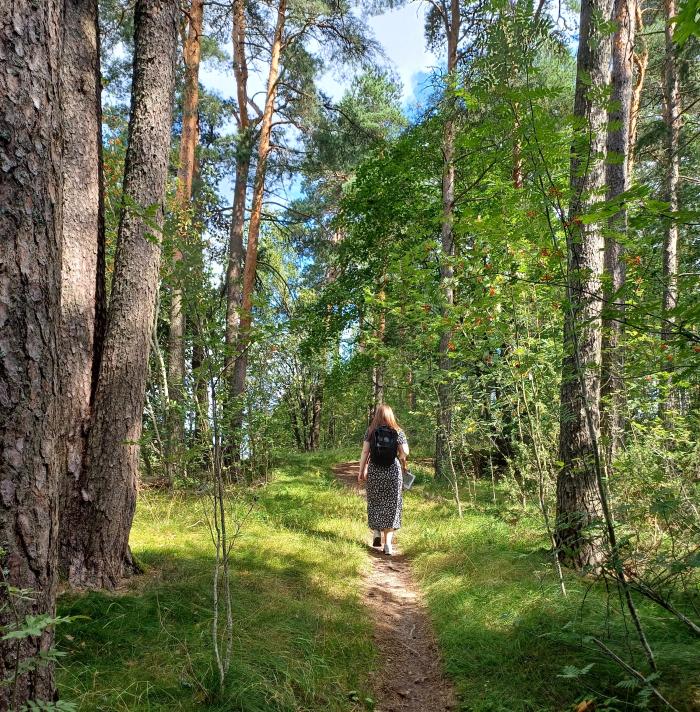
The biodiversity park is located in the Skanssinmäki area, which has a diverse history of human use. In the 1970s, the Skanssinmäki ridge was still a gravel extraction site. Since then, the area has become overgrown and, as the years have passed, it has been used for many different purposes – it previously hosted the rescue dog association’s rubble track, provided a recreational environment for citizens, and the forest has also accumulated waste and abandoned items.
The park covers an area of 20 hectares and will encompass 21 approaches to conserve and actively enhance urban biodiversity. The area’s development will be monitored, and maintenance measures will support nature’s recovery.
-
Nonetheless, the project does not only create a biodiversity park, it also focuses on enhancing biodiversity more broadly in urban nature and seeks to raise awareness among residents, decision-makers, and entrepreneurs. The project is testing smaller-scale biodiversity pilots in two pre-selected neighbourhoods in Turku and engaging local communities to improve their living environment.
In addition, the park itself will carry more value than simply providing a more biodiverse environment for different species. It will be developed as a participatory learning platform for various target groups, such as students and citizens. Some of the developments in the park have also been carried out not only by the city but in collaboration with residents and students. This has helped to increase citizens’ understanding of biodiversity.
-
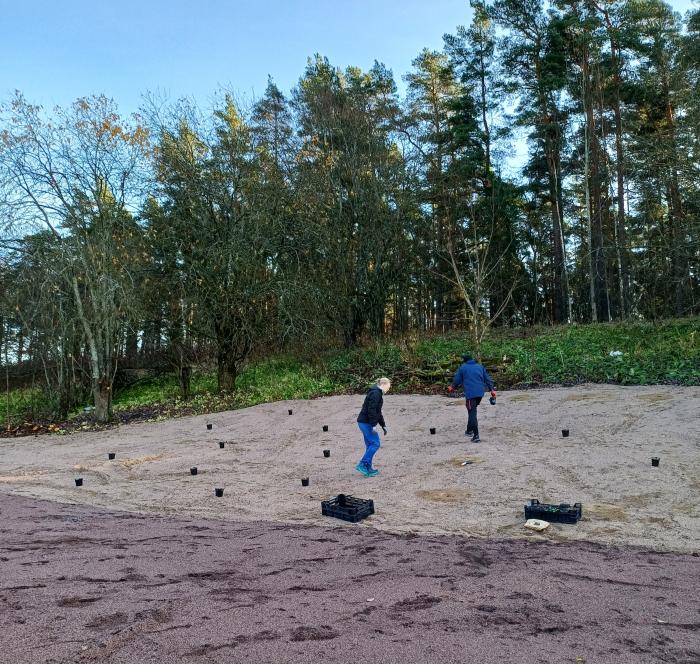
Planting local species in an accumulation area that will serve as a seed bank.

-
Establishing the foundations of a calcareous meadow. Later, plants will be planted in calcareous soil.
What has already been done and what lies ahead
By the beginning of 2026, several renovation works had already taken place. So far, these works have included clean-up operations, small gap cuttings to diversify the age structure and species composition of the forest, establishing the foundations of a calcareous meadow, and sowing local plant species in an accumulation area. As 2026 begins, park renovation work continues, with plans to create features such as a wetland, a calcareous meadow, and a dog enclosure. In addition, a landscape artwork using charred trees is being implemented in the park.
At this stage of the project, it is also crucial to start considering a management and use plan for the period after the project concludes. As outlined above, the park will undergo several changes during the project. Nonetheless, what happens after the project concludes is just as important. Nature takes time to grow and evolve, so when the project finishes in August 2027, it will mark only the beginning from the park’s perspective.
Watch the video below to learn more about the Skanssi biodiversity park. Experts from different fields explain what is being done in the park. You can also switch the subtitles to English.