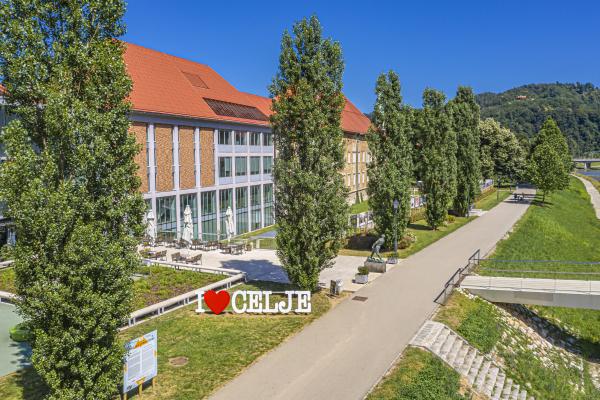
From learning to leading: How Celje’s European journey sparked a new chapter of urban innovation

Fresh from hosting the European Urban Initiative (EUI) national capacity-building event “Integrating horizontal principles in sustainable urban development” at Technopark Celje, we sat down with Monika Tominšek, Head of Development Office and co-leader of the project MAG-NET, to talk about Celje’s transformation.
Her reflections reveal a story that many cities will recognise: a moment of learning that sparked confidence, a project that helped them grow, and a journey that continues as they support others in doing the same.
“We want Celje to be a place where people feel they can build a good life.”
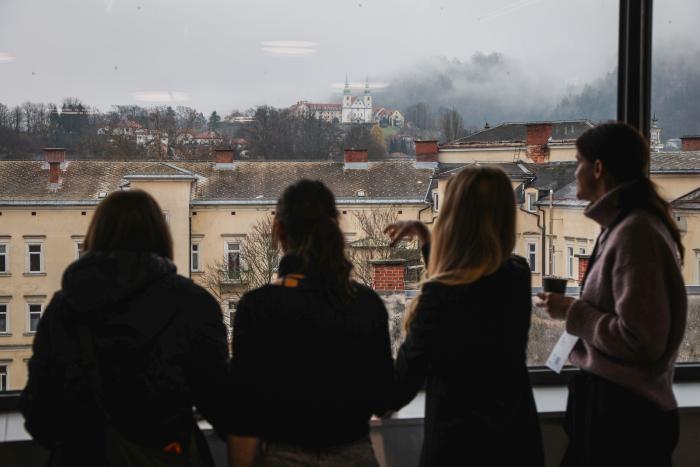
Celje
Celje’s priorities speak to the heart of urban development: its people.
“We want to keep young people in Celje and attract new talent back or from elsewhere,” Monika explains. “Slovenia is very centralised, and this impacts on the development of other regions - especially when it comes to attracting and retaining talent.”
Housing accessibility, demographic change, greener mobility, energy transition and the shift toward Industry 4.0 and higher value jobs, all shape the city’s agenda. But Celje is paying just as much attention to the intangible “urban vibe” - creating a city where culture, sports, innovation and everyday life connect in a way that makes people want to stay.
And this work cannot be done from behind a desk.
“Participation, trust and co-creation are becoming core to how we plan Celje’s future.”
A capacity-building moment that changed the city’s direction
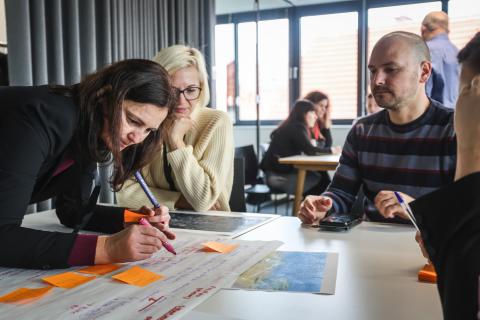
Calje-CB
An experienced partner in URBACT networks, Celje’s journey with the European Urban Initiative began quietly, almost imperceptibly - a peer-to-peer review in Vicenza, followed by a capacity-building session in Ljubljana. Yet those first encounters with the EUI community proved far more influential than anyone expected.
“They helped us see our challenges differently,” Monika reflects. “And they helped us believe we could try something bigger.”
For a city navigating talent loss, housing pressures and a changing economy, these early exchanges shone a light on something Celje hadn’t fully confronted: entrenched silos within the city ecosystem and also within the administration - the need for stronger cross-sectoral and cross-departmental cooperation respectively, and the real risk of falling further behind if nothing changed.
What began as two modest learning moments quickly grew into a catalyst. The experience continues to prompt deeper reflection inside the municipality, strengthening collaboration among departments, and ultimately encouraged Celje to explore new opportunities within EUI - momentum that eventually led the city to take a far more ambitious step: preparing a successful application to the EUI Innovative Actions programme.
Learning into practice: applying new skills, changing the way the city works
Asked how participation in European programmes influenced city practice, Monika describes a cultural shift that many cities will find familiar:
“We now involve people much earlier - not just at the end. We try to understand problems better, using data and real analysis. We test ideas on a small scale first. And cooperation with institutions, businesses, NGOs and schools has become natural.”
Perhaps most importantly, Celje stopped thinking in isolated “projects” and started thinking in terms of long-term transformation.
This is exactly where capacity building becomes more than a training session: it becomes a catalyst for a new way of governing.
MAG-NET: the moment Celje stepped forward
Building on the new practices, confidence and mindsets strengthened through EUI Capacity Building and peer learning, with its growing confidence and new skills, Celje took a bold step by leading an application to the EUI Innovative Actions (IA) Call 2. This resulted in MAG-NET, a project to tackle talent attraction, urban vibrancy and innovation.
“For us, MAG-NET is more than a project - it’s a turning point,” Monika says. “It brings together 10 Slovenian partners and three international cities. It’s highly participatory and meant to achieve long-term impact.”
The project focuses on five interconnected domains, namely affordable housing, sustainable mobility, Industry 4.0 (higher value jobs), urban vibrancy and energy communities.
Together, they form a systems-level approach that aims to make Celje a magnetic place for living, working and creating.
But equally important is what MAG-NET proves: small cities can lead major European innovation projects - and do so with ambition.
Experimenting and rebranding: “a chance to rethink our direction”
EUI funding allowed Celje to experiment in ways that would not have been possible otherwise.
“EU funding was the only realistic way to try something new,” Monika explains. “Not just infrastructure - but a chance to rethink our direction.”
This shift includes early involvement of residents, iterative, test-before-invest approaches, rethinking governance, and beginning a much-needed rebranding of Celje.
Transformation, in other words, is becoming visible not only in projects but in the mindset shaping them - and that mindset shift is perhaps the most powerful change of all.
City-to-city learning: strengthening capacity through peers
Celje is now applying for a city-to-city exchange with Ghent, focusing on neighbourhood renewal.
“The exchange focuses on affordable housing, social inclusion and climate resilience,” Monika says. “Ghent’s experience with participation and cooperative housing models is extremely relevant. Their models for affordable and inclusive housing - such as community land trusts and cooperative approaches - can directly support Celje’s 1st Housing Programme 2025-2032 and MAG-NET activities.”
The exchange is not an isolated activity - it is a continuation of the learning journey that began in Vicenza and Ljubljana.
It’s clear that each step builds on the previous one: capacity building → experimentation → application → deeper learning → new exchanges → stronger city.
Listening to Monika, one gets the sense that Celje’s journey is far from over. The city has found a rhythm of learning and collaboration that is likely to carry it into new opportunities, new partnerships and new forms of innovation still to come.
Hosting a capacity-building event: from learner to contributor
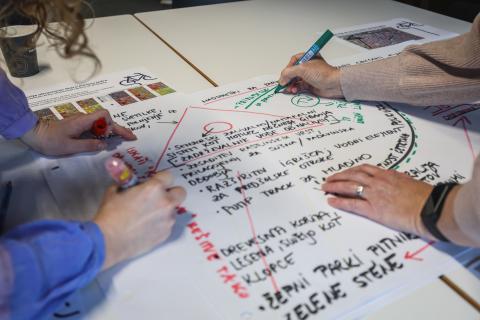
Celje-CB
Hosting the recent EUI event in Celje marks a new chapter.
“We were inspired by earlier EUI sessions that helped us develop MAG-NET,” Monika shares. “Hosting the event shows that a small city can lead a complex innovation project - and it helps decentralise Slovenia. Not everything has to be in Ljubljana.”
Hosting is not just symbolic. It is an opportunity for Celje to share what it has learned, connect with peers and support other cities that are where Celje once was.
This is the full circle of capacity building: learning, doing, sharing.
A message to smaller cities: “Don’t copy - invent”
In light of the EUI Call 4 launching at the beginning of 2026 - including grants of up to €2 million and a flexible definition of innovation (“new at the local level”) - Monika offers encouraging advice:
“Go for it! Start with a concrete issue people care about. Keep the idea simple, build strong partnerships, and don’t be afraid to try something new.”
And then she shares something that perfectly captures Celje’s philosophy:
“Don’t copy - invent. Be first at something in your local environment. Innovation doesn’t always need big budgets - sometimes it’s enough to change the process, ask better questions and bring the right people around the table.”
Inspiring a new generation of small-city innovators
Celje’s journey is not one of overnight transformation. It is a story of how a city embraced learning, trusted the process, built confidence, and used that momentum to create something bigger than any individual project.
It shows that:
- capacity building can trigger major strategic change,
- small cities can lead ambitious innovation,
- peer learning accelerates transformation, and
- every city, regardless of size, has something valuable to share.
What Celje demonstrates is that the EUI is more than a set of separate offers - it is an ecosystem. Capacity building sparks reflection, peer learning accelerates change, and Innovative Actions give cities the tools to turn ideas into reality. When these elements come together, even small cities can unlock major transformation.
As Monika’s experience shows, progress often starts with a single step - a willingness to engage, to listen, and to imagine something different for the city.
For many municipalities across Europe - whether considering a peer review, a city-to-city exchange, the next EUI call, or simply looking for a starting point - Celje offers an encouraging message:
Transformation begins the moment you decide to learn.