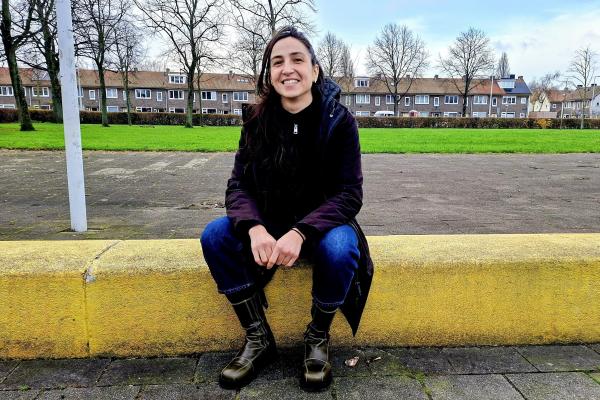
Pinar explores the rhythm of Tuindorp
We meet at community center De Evenaar, where it is warm and cozy on this winter afternoon. Around a large table, local residents are intently sculpting; the smell of coffee fills the air, and people cheerfully greet one another. Pinar watches with visible pleasure. “What strikes me every time is how much is organized here,” she says. “Walking groups, courses, coffee moments… An incredible amount is happening in Tuindorp Oostzaan, for and by local residents."
Dozens of conversations
Yet a rich offer is not automatically the same as a suitable one. That is why part of Pinar’s research also focuses on how residents of Tuindorp spend their days and whether activities match their wishes and needs. To find this out, Pinar conducted dozens of conversations with residents, mapping their daily patterns. Pinar explains: “For example, we asked where people do their shopping, what their leisure time looks like, and which places play a key role in their week. We also looked at age, length of residence, location within the neighborhood, and family composition. This helps us understand why people have certain daily and weekly rhythms.”
Meaningful patterns
What stood out most to Pinar were the small but meaningful patterns. “Many residents enjoy being creative at home. It would be great if people could also do that together. It’s not so much about adding yet another activity or course, but about creating opportunities to meet new people while doing something you both enjoy.” The conversations also revealed that many people are happy about larger, annual events where long-time and new residents, young and old, can meet. “Think of a Christmas celebration, a summer festival, or a pancake day. Activities like these help people make connections and strengthen their bond with the neighborhood. So perhaps these could be organized more often. And in Tuindorp Oostzaan there is certainly enough space for this, for example at Plejadenplein.”
Similarities
In addition, Pinar observed that there are many similarities among the residents of Tuindorp Oostzaan. “There is often talk of contrasts between ‘old’ and ‘new’ residents, but in my research I mainly see shared interests, for instance in art or music. Everyone also longs for conviviality and connection.” Of course, there are differences as well. “Not everyone is active at the same time. Low-threshold activities can then be a way to bring residents together anyway. What also stood out to me is that almost everyone—from people in their twenties to those in their seventies—likes going to the NDSM Wharf or to other places in the city. There is clearly a strong sense of connection with the rest of Amsterdam.”
Pride
What truly sets Tuindorp apart, according to Pinar, is that residents are incredibly proud of their neighborhood. “That applies not only to people who have lived here for a long time, but also to newer residents. It’s wonderful to see how that sense of involvement comes up in so many conversations. For the neighborhood itself, this may not come as a big surprise, but it is valuable to see that my research confirms this feeling. And we hope to show where there are still opportunities. Ultimately, it is up to the residents, community workers, and the municipality to work with these insights.”
Similarities
In addition, Pinar observed that there are especially many similarities among the residents of Tuindorp Oostzaan. “People often talk about contrasts between ‘old’ and ‘new’ residents, but in my research I mainly see many shared interests, for example in art or music. People also all long for a sense of conviviality and connection.” Of course, there are differences as well. “Not everyone is active at the same time. Low-threshold activities can therefore be a way to still bring residents together. What also struck me is that almost everyone—from people in their twenties to those in their seventies—likes going to the NDSM Wharf or to other places in the city. There is clearly a strong sense of connection with the rest of Amsterdam.”