Tallinn
SOFTacademy - Demonstrating a model of collaborative pre-fabricated reinvention of modernist districts into cozy living environments
About the project
The SOFTacademy project seeks to accelerate neighbourhood level circular renovation of large, multi-owner apartment buildings.
To create a truly integrated, dense and diverse urban ecology, this approach to renovation considers not only resource efficiency, but also environmental, social and economic sustainability.
Using a hardware and software approach, the project demonstrates how residents’ initiatives in renovation can boost the re-design of a whole neighbourhood, including the spaces between buildings.
In this way, the project is developing a collaborative innovation model for urban governments to accelerate private renovation by improving overall urban liveability, creating a better local micro-climate, increasing biodiversity, accommodating community functions, changing the scale of buildings, and creating a ‘cosier’ living environment where people can meet and relax, and feel they belong. The intervention logic and digital tools developed as part of the solution are transferable to any mass-produced, monofunctional apartment building district that needs not just renovation but also an improved sense of place and identity.
Challenges
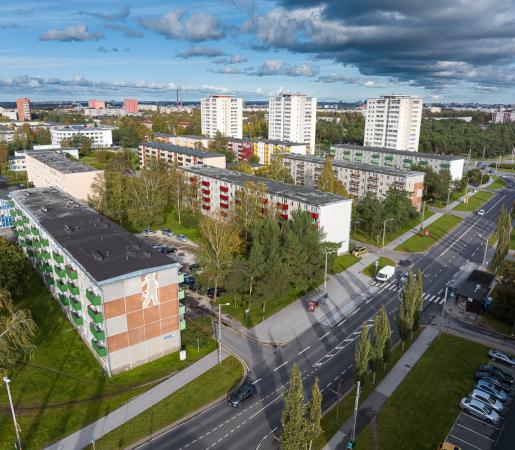
The design of Tallinn’s Mustamäe 1963 prefab apartment blocks prioritised functionality, cost, and the limits of cranes. Today, this monofunctional district, with its high population density (~150-250 people/ha), urgently needs renovating. Buildings are deteriorating due to poor thermal insulation, limited accessibility, and worn-down common spaces and building exteriors. Neighbourhood level re-design is needed, with a focus on liveability: creating an integrated, dense and diverse urban ecology.
-
Tallinn’s deteriorated modernist monofunctional districts need urgent energy performance improvements to save inhabitants from deepening energy poverty. The city needs to establish a systematic change model and tools to meet this multifaceted challenge.
-
Tallinn needs to accelerate the renovation of modernist housing districts to meet the goals of the Estonian Long-term Renovation Strategy and Tallinn Sustainable Energy and Climate Action Plan 2030.
-
Mass-produced, multi-storey apartment buildings dominate the suburbs of cities across the former Soviet Union and beyond. To be on track with 2050 climate goals, direct CO2 emissions from this type of building need to be decreased by at least 60%.
Proposed solutions
SOFTacademy is developing, and putting into practice, a model for urban governments to accelerate private renovations by improving overall urban liveability. This new, collaborative renovation model supports the co-creation of neighbourhoods using ‘prefabricated elements’ both for buildings and the spaces between them. For example, prefabricated modules with insulation panels and new windows are produced in a factory, then transported and installed onsite, saving time and allowing residents to stay.
-
Modernist districts are not designed to be socially inclusive. So, achieving a ‘cosier’, more inclusive, living environment also requires a shift in urban culture. SOFTacademy’s co-creation tools will help to facilitate such community inclusion.
-
The intervention logic, and digital tools, developed as part of the solution are transferable to any mass-produced, monofunctional apartment building districts that need not just renovation, but also an improved sense of place and identity.
-
SOFTacademy aims to serve as a good example for other municipalities in facilitating co-creation in the context of neighbourhood level renovation.
Milestones
Spatial components applicable as standard solutions for regenerating neighbourhoods with a holistic approach
Challenge-specific support for aligning building stock's renovation strategy with residents’ needs
Municipal service to facilitate and accelerate private renovations in Tallinn based on the digital catalogue of modules for renovations and urban environment regeneration created in the SOFTacademy project
Deep renovations of four apartment buildings
Increasing biodiversity and creating a greener, ’cosier’ living environment